




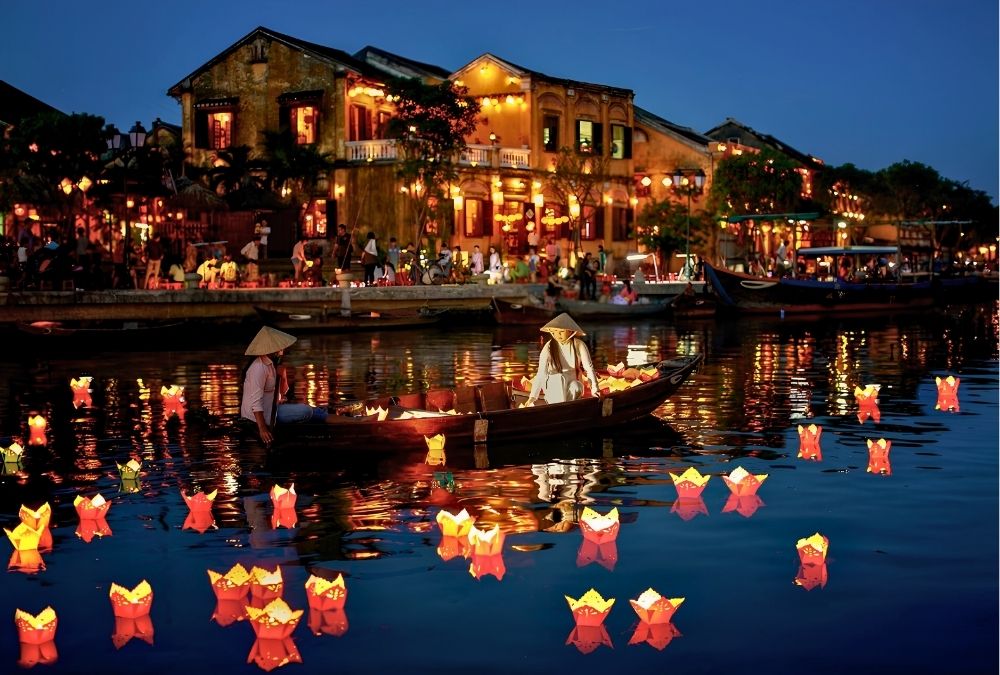
Around six in the evening on the 14th of the lunar month, Hoi An quietly changes its mind about what kind of town it is. Motorbikes are kept out of the Old Town, shopfronts dim their bulbs, and the yellow walls turn the colour of candle wax. On the Hoai River, small paper lanterns drift past in slow, glowing lines, and somewhere down a side lane a caller starts the first verse of a bai choi game.
- What is the Hoi An Lantern Festival?
- Hoi An Lantern Festival Dates in 2027
- A suggested Hoi An Lantern Festival itinerary
- 4:00-5:30 pm: Eat dinner early and find a view
- 5:30-6:30 pm: Walk the Lantern Streets and see the Japanese Covered Bridge
- 6:30-8:30 pm: Take a boat and float a lantern on the Hoai river
- After 8:30 pm: The night market and the quiet streets
- Tips for photographing lanterns on a phone
- Practical notes before you go
- FAQs
This is Dem Ram Pho Co, the Old Town Full Moon night. It costs nothing to walk through and is surprisingly easy to enjoy badly. This guide sets out the 2027 dates and what an evening really costs, then follows the night hour by hour, from an early dinner to the last quiet walk, so you can stay ahead of the crowd.
What is the Hoi An Lantern Festival?
The Hoi An Lantern Festival takes place monthly on the 14th day of the lunar calendar, when the Old Town recreates the atmosphere of its historic trading-port evenings with lantern light, riverside activities and traditional folk games. The monthly event has been held since 1998, while Hoi An’s Old Town became a UNESCO World Heritage Site in 1999 (Source: hoianworldheritage.org.vn).
The lanterns are the heart of it. Local accounts say the craft began with a maker of lion heads and festival lanterns known as Xa Duong. At first, only wealthy families hung large painted lanterns inside their homes, and it took several generations for the lantern to reach every house.
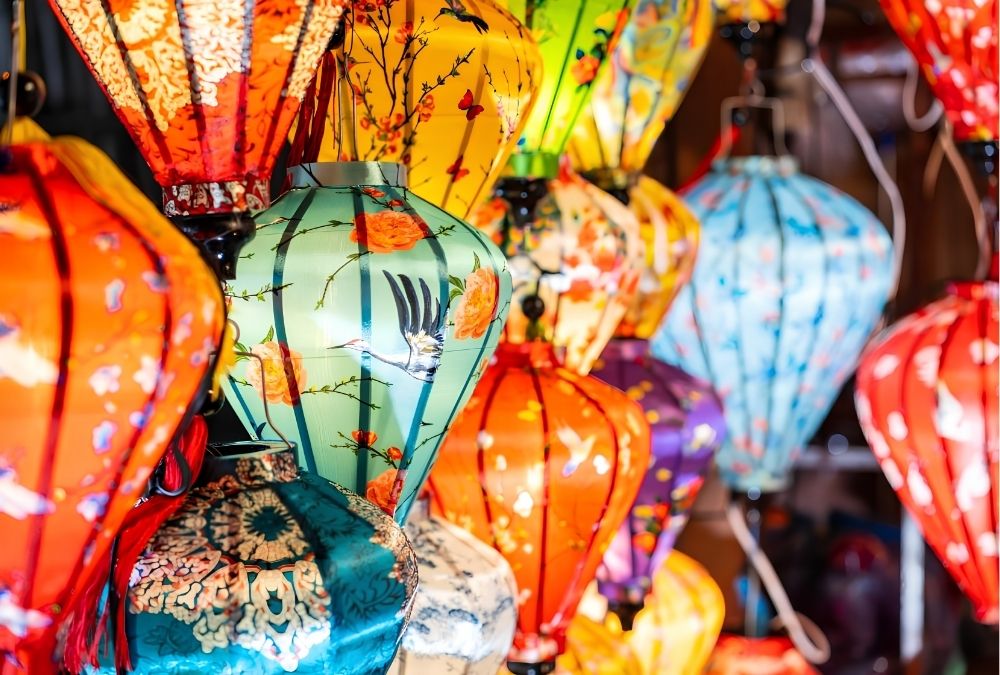
What makes a Hoi An lantern different:
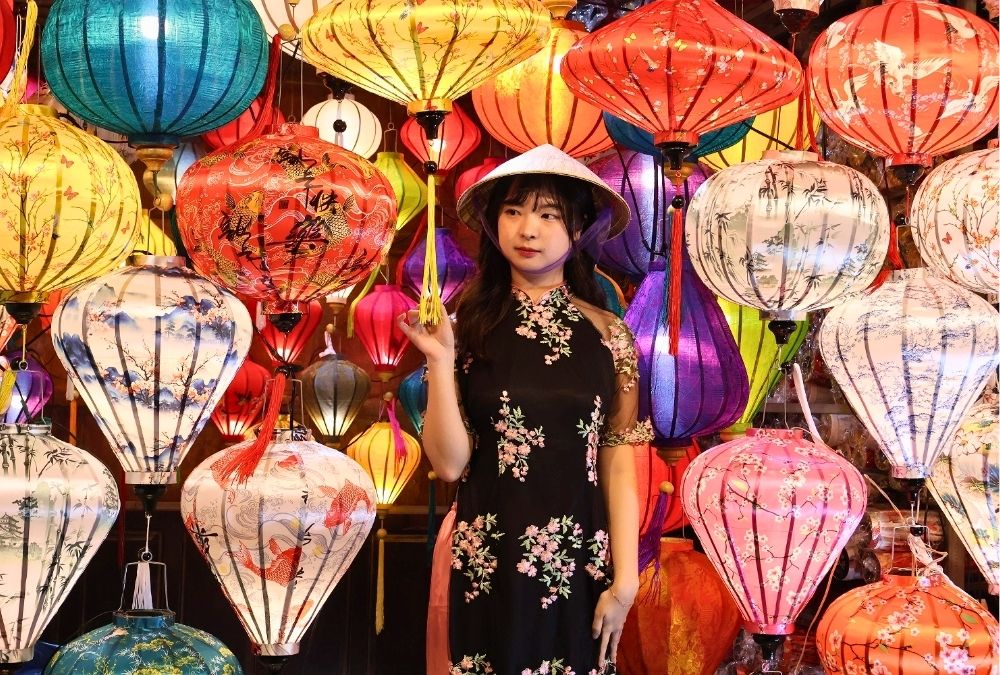
- Materials: bamboo frame and silk cover, traditionally Ha Dong silk, whose fine weave softens the flame into a warm glow.
- Purpose: the word “lantern” means “to give light”, so lanterns are meant to be lit, not just hung.
- Round shape: the classic Hoi An style, said to stand for harmony and balance and to bring warmth, peace and luck to a home.
- Other shapes: garlic bulbs, rice dumplings and six-sided revolving lamps.
Walking the streets of Hoi An Ancient Town is free, but a heritage ticket is required to enter selected sites. The 80,000 VND ticket includes access to either the Japanese Covered Bridge or Quan Cong Temple, plus two additional heritage sites. For a more extensive visit, the 120,000 VND ticket includes one of these two landmarks, access to Hoi An’s museums and three additional cultural sites.
Hoi An Lantern Festival Dates in 2027
The Hoi An Lantern Festival follows the lunar calendar and takes place on the evening of the 14th, just before the full moon. This detail matters when planning your visit, as arriving on the following night means missing the main celebrations.
Lunar date | Festival night | What makes this night different |
14th of month 12 | Thursday 21 January 2027 | The last full moon night of the Year of the Horse, with cool, dry winter air |
14th of month 1 | Friday 19 February 2027 | Nguyen Tieu, the first full moon after Tet and the biggest night of the year |
14th of month 2 | Sunday 21 March 2027 | A pleasant spring night, a few days before the Quan The Am festival at Marble Mountains in Da Nang |
14th of month 3 | Tuesday 20 April 2027 | A weeknight just after the Hung Kings’ Commemoration holiday on 16 April |
14th of month 4 | Wednesday 19 May 2027 | The evening before Buddha’s Birthday, so the pagodas are decorated and busy |
14th of month 5 | Friday 18 June 2027 | Early summer: hot, dry, and a Friday night, so weekend visitors arrive early |
14th of month 6 | Saturday 17 July 2027 | A midsummer Saturday, warm and lively, with a lighter crowd than February |
14th of month 7 | Sunday 15 August 2027 | The evening before Vu Lan, when many Vietnamese families visit pagodas |
14th of month 8 | Tuesday 14 September 2027 | The evening before Mid-Autumn Festival, when children carry lanterns through the streets |
Which night should you choose?
If you only get one, make it 19 February 2027. Tet falls on 6 February that year, so this is the first full moon of the new year. Hoi An begins its Nguyen Tieu celebrations early, stretching them over three days from the 14th to the 16th, and the Old Town is dressed more generously than in any other month. The price of that generosity is a crowd. On the same night in 2025, boat services along the river were stretched past their limits, and people queued patiently anyway because nobody wanted to miss the evening.
The first three months of the year are Hoi An’s most comfortable season, with cool air and only occasional light rain. From September to December the rains arrive and the river sometimes rises. Bach Dang is the lowest street in the Old Town and the first to flood, and when the water is high the rowing boats may be restricted. If you are travelling in the wet months, check the forecast the same afternoon.
If crowds bother you more than grandeur does, the quieter nights of May to August are gentler.
A suggested Hoi An Lantern Festival itinerary
Time | What to do |
4.00 – 5.30 pm | Faifo Coffee terrace, or an early bowl of cao lau or chicken rice |
5.30 – 6.30 pm | Photograph the Japanese Covered Bridge and the yellow-walled streets while they are still quiet |
6.30 – 8.30 pm | Queue for a boat, release a lantern, watch the Old Town go dark |
8.30 – 9.30 pm | Cross to the Nguyen Hoang night market, or eat late on Tran Hung Dao |
After 9.30 pm | Walk the emptying streets one more time |
Parking is easiest at the edge of the Old Town, along Phan Chau Trinh or Hoang Dieu, and the rest is a walk. For photos, flash stays off, night mode needs a still hand, and the first minutes of the boat ride, with light spilling from the shore, give the best shots.
4:00-5:30 pm: Eat dinner early and find a view
By 7 pm the famous chicken rice and cao lau restaurants have queues. Eat between 4.30 and 5.30 pm instead, when kitchens are calm and bowls arrive quickly. The streets away from the pedestrian core, around Tran Cao Van and Phan Chau Trinh, or across the river on Nguyen Phuc Chu, are far more relaxed than the Tran Phu strip. If you want a late dinner after the boat ride, Quan An Co Eo on Tran Hung Dao stays open until about 10 pm.
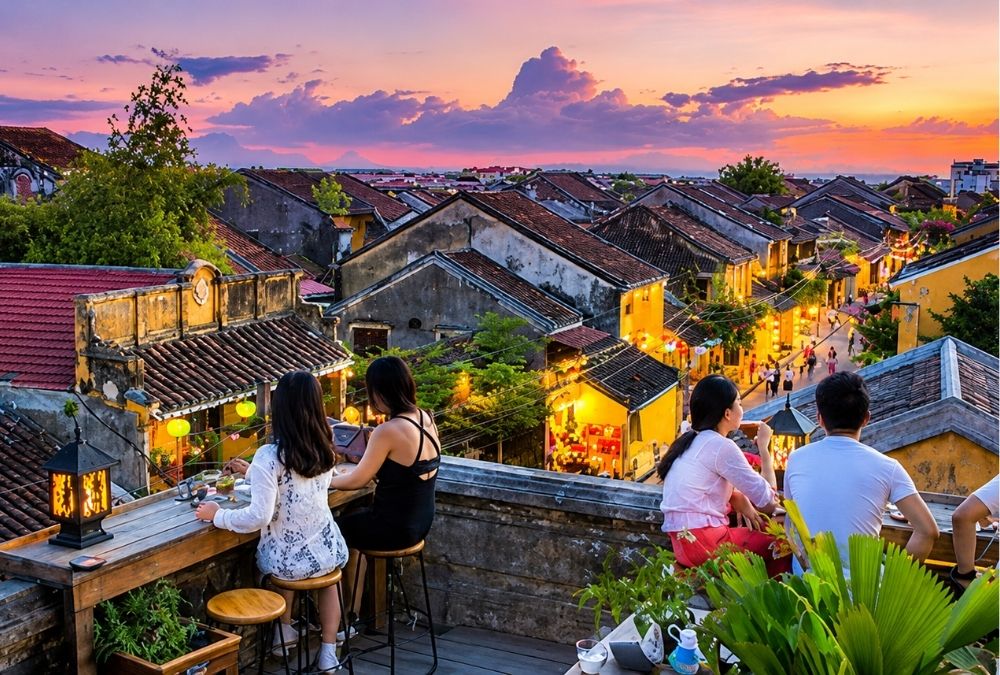
Before the light fades, climb to the third-floor terrace of Faifo Coffee on Tran Phu. From there the town looks like a sea of mossy tiled roofs and saffron walls, and you can watch the afternoon slide into lantern light. Seats go early, so arrive before 4 pm. The cafe closes at 9 pm, which leaves enough time to see the street change.
Read more: Hoi An Street Food Tour
5:30-6:30 pm: Walk the Lantern Streets and see the Japanese Covered Bridge
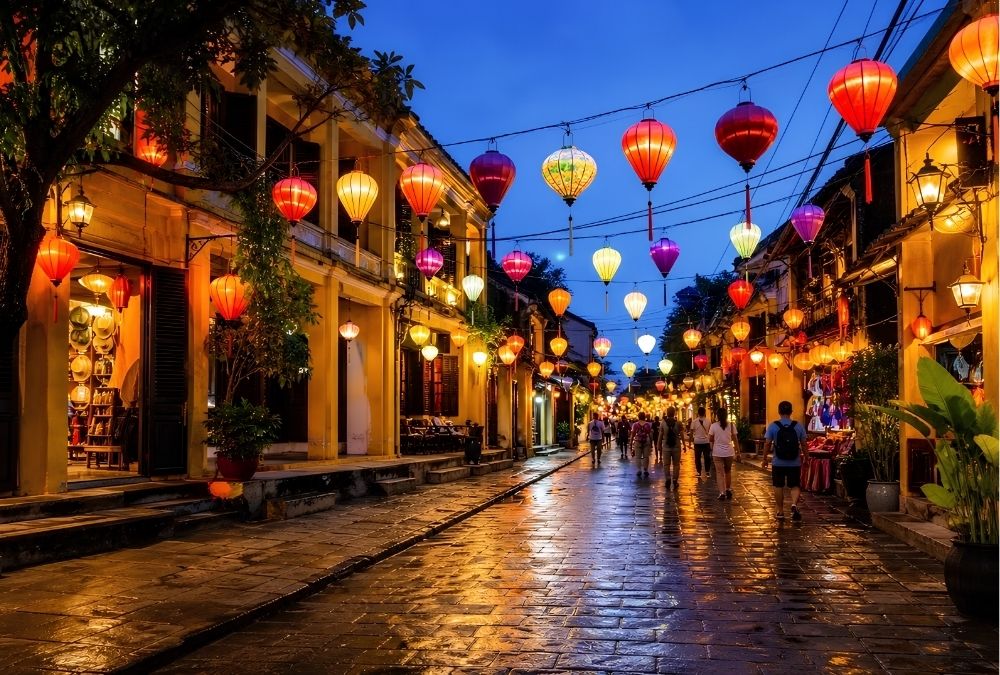
This is the hour to walk while the Old Town is still calm. Entrances clog from about 6 pm, so leave your bike on the edge, along Phan Chau Trinh or Hoang Dieu, and go in on foot.
The Japanese Covered Bridge, built in the 17th century, is where the evening’s traffic jam happens. Between 7.30 and 8.30 pm the crowd around it shuffles forward one slow step at a time. Photograph it now, or from the opposite bank, when the light is still gold and the bridge is nearly empty. It empties out again after 9 pm, when the tour groups head back to their buses.
Meanwhile the electric lights fade. Somewhere between 7 and 9 pm the Old Town is dark enough for the lanterns to take over completely, and that is the stretch many people remember afterwards.
6:30-8:30 pm: Take a boat and float a lantern on the Hoai river
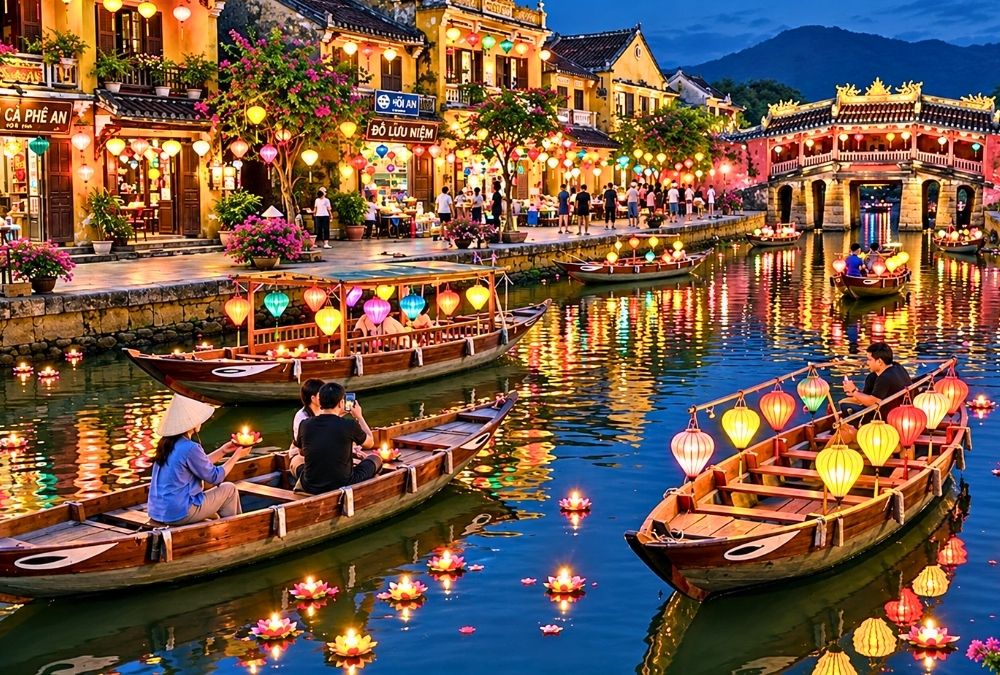
One of the most memorable experiences at the Hoi An Lantern Festival is releasing a small paper lantern, known locally as hoa dang, onto the Hoai River. The candlelit lanterns symbolise wishes for peace and good fortune, and some local families also release them as offerings to their ancestors.
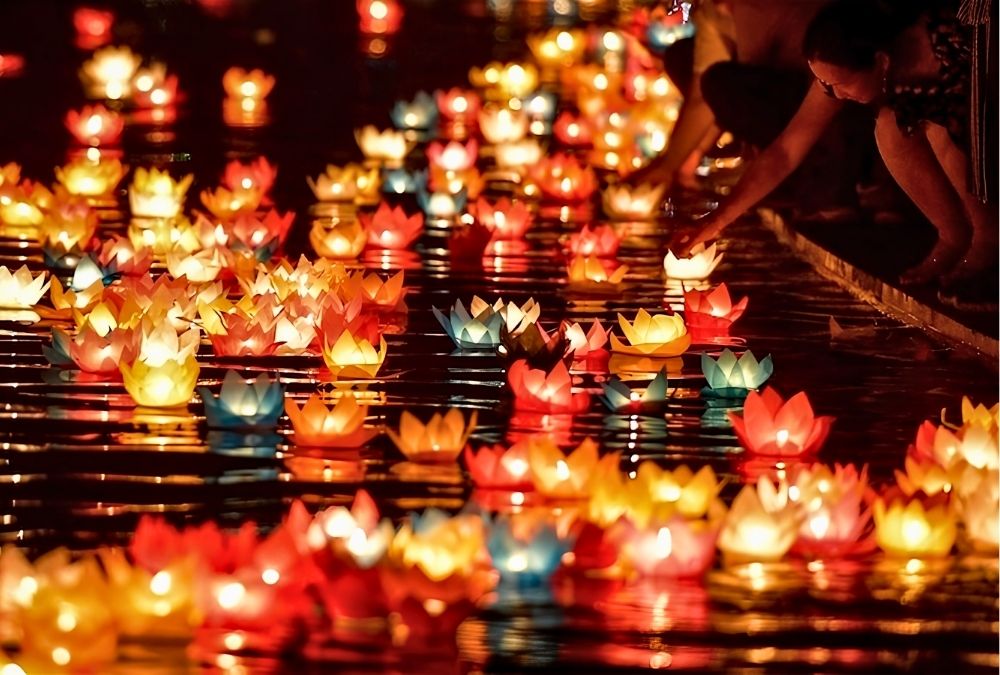
How to do it well:
- Buy from the sellers on the bank, not on the boat. Prices are lower.
- Light the candle first, then lower the lantern gently onto the water. A thrown lantern tips over and goes out.
- For the boat ride, buy a ticket at the official counters along Bach Dang near the An Hoi footbridge, where staff wear identification badges and prices are posted.
Item | Typical cost |
Walking the streets during the festival | Free |
Paper floating lantern | 5,000-15,000 VND |
Boat for 1-3 people (15-20 minutes) | 150,000 VND |
Boat for 4-5 people | 200,000 VND |
Old Town heritage ticket (enters five heritage sites, not needed to walk the streets) | 120,000 VND |
The river is lovely and the trade around it is not always honest. The common tricks are easy to dodge once you know them.
- “The main pier is closed”: People near car parks or crossroads, several hundred metres from the counters, will tell you the dock has shut and offer a cheaper private boat. The official dock is open. Walk to it yourself.
- Motorboats on the dark stretch: The best part of the ride is the short section of river in front of the Old Town, covered by small rowing boats. Motorboats tend to run to stretches with no lanterns at all.
- The “coconut forest” detour: A few boatmen on the Bach Dang wharf offer a trip to a coconut forest that turns out to be a row of palms by a roadside, not the real water-coconut forest of Cẩm Thanh.
- Inflated prices: One group paid 500,000 VND for three people for a 30-minute ride arranged off the counter, more than three times the posted rate.
- Repeated requests for a tip: A small tip for a good ride is customary, but it is entirely your choice.
Read more: Hoi An City Tour, Boat Ride & Flower Lantern Release
After 8:30 pm: The night market and the quiet streets
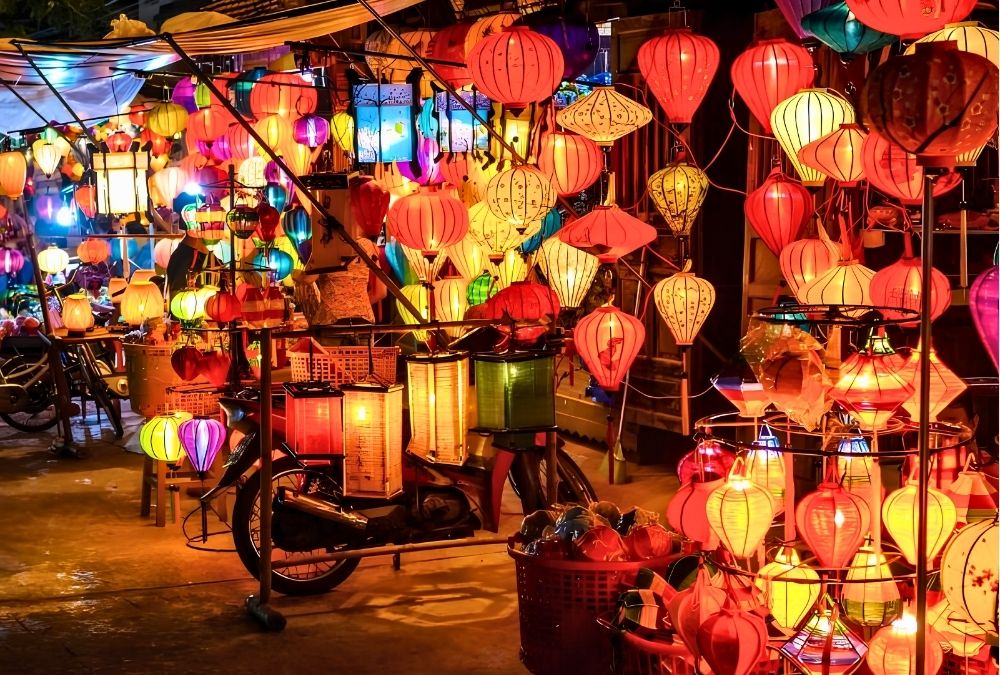
Once you step off the boat, cross the An Hoi footbridge to the Nguyen Hoang night market, open until about 10 pm. It is a long street of lanterns, handmade souvenirs and snack carts, and also the loudest and most crowded corner of the Old Town on a full moon night. Souvenir prices start high, so bargaining is expected, and many stalls sell nearly identical bamboo goods.
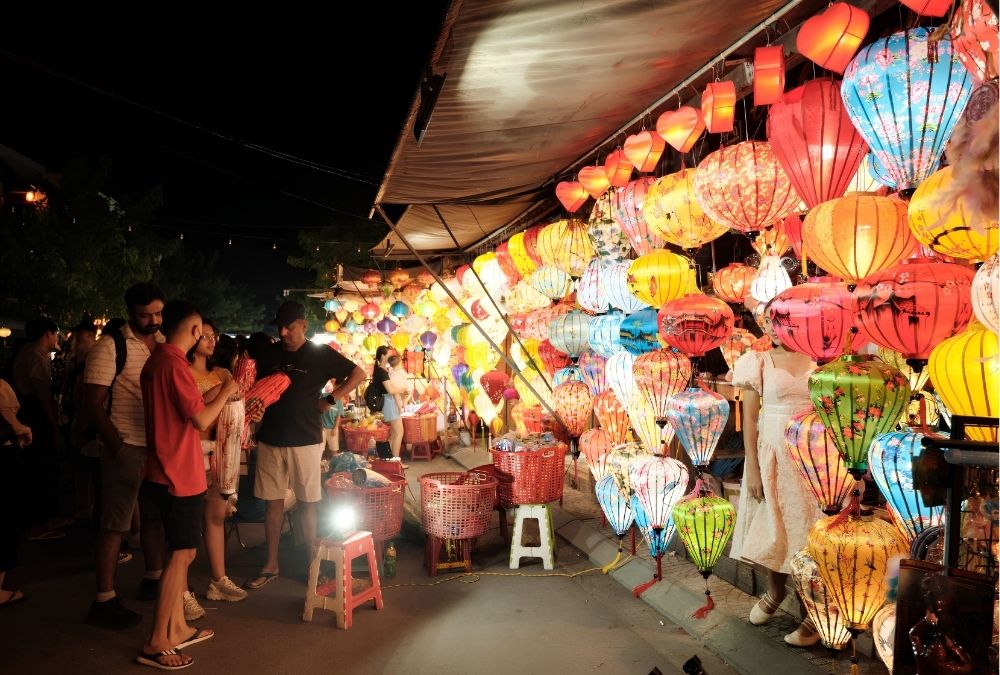
Eat here with a little selectivity. Grilled skewers cost 15,000 to 20,000 VND, tube ice cream 5,000 to 10,000 VND, and a bowl of sweet soup 15,000 to 25,000 VND. Choose the skewer cart grilling over live red coals rather than the one with pre-cooked meat sitting cold on a plate. For sweet soup, walk to the far end of the market or duck into a side alley, where the seating is calmer and the che is lighter.
Some lantern shops hang a “photo fee” sign. Buying a small lantern for 20,000 to 50,000 VND, or offering 10,000 to 20,000 VND, is the simplest way to take your photograph without awkwardness. For a quieter frame, walk the lanes off Tran Phu and Nguyen Thai Hoc, where small cafés and homestays hang lanterns more sparingly and there is room to stand.
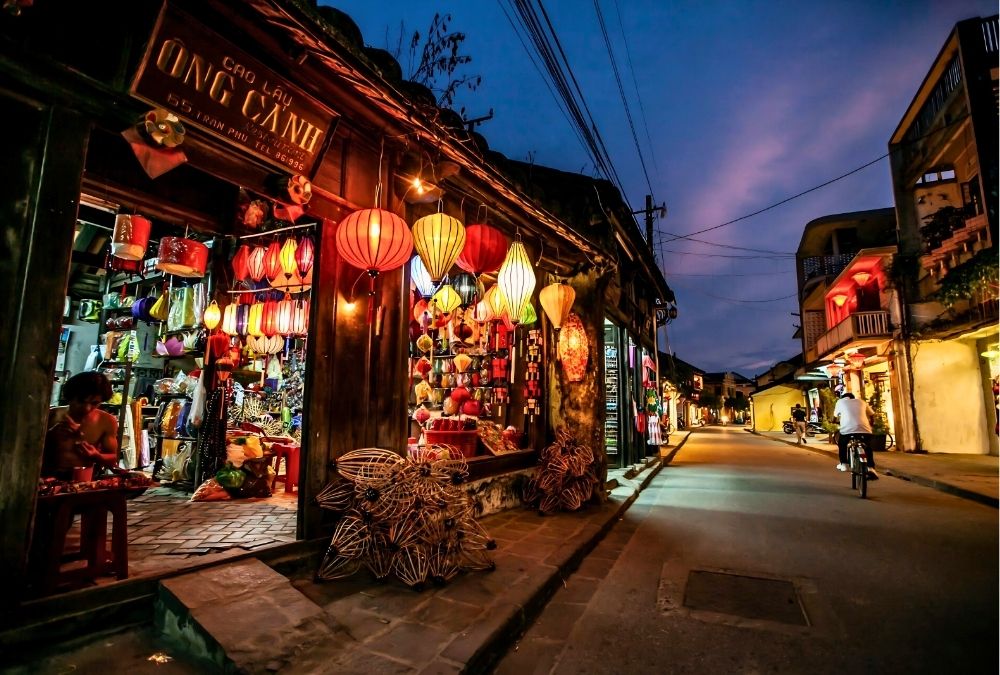
The best hour comes last. After about 9.30 pm the tour groups have gone and the shops are closing, and the Old Town settles back into stillness: wet stone, flat water, a few faint lanterns. Many people who stay on find it the most atmospheric part of the whole evening.
Read more: Hoi An Ancient Town Walking Tour
Tips for photographing lanterns on a phone
- Turn the flash off. It bleaches faces and turns the glowing background black.
- Use night mode and hold still for a few seconds. On a boat, rest your elbow against the side.
- Tap the lantern to focus, then drag the brightness down a little so the colour stays rich instead of washing to white.
- Shoot in the first two minutes of the ride, while there is still light spilling from the bank. Out in the middle of the river it is very dark and phone photos turn grainy.
- Hold a lantern close to the lens so the crowd behind you blurs into soft light.
Practical notes before you go
Crowds around the bridge and the night market are dense enough for pickpockets, so keep your phone in a front pocket and your wallet out of sight. Hand over exact amounts where you can, and check your change in the dark. If you are heading for the February night, book your room early, because it is the evening when Hoi An fills up faster than any other.
The Hoi An Lantern Festival rewards a little planning more than almost any other evening in Vietnam. Walking through the Old Town is free, a floating lantern costs less than a coffee, and a boat ride can be affordable when booked at the official counter.
Eat early, photograph the Japanese Covered Bridge before the crowds arrive, take a boat from the official dock, and save the quiet streets for last. Follow this order and the Hoi An Lantern Festival becomes more than a crowded photo stop: it offers time to appreciate the Old Town’s lantern-lit streets, riverside traditions and quieter moments after dark.
FAQs
When is the Hoi An Lantern Festival in 2027?
The festival takes place on the 14th day of each lunar month. Key dates include 19 February, 18 June and 14 September 2027.
Is the Hoi An Lantern Festival free to attend?
Yes. Walking through the Old Town is free. You pay extra for activities such as floating lanterns, boat rides and visits to heritage sites.
How much does a boat ride cost during the Hoi An Lantern Festival?
A 15-20-minute ride typically costs 150,000 VND for 1-3 people or 200,000 VND for 4-5 people.
What is the best time to visit the Hoi An Lantern Festival?
Arrive around 4-5 pm to explore before peak crowds. After 9:30 pm, the streets become quieter and more atmospheric.
Where can you release floating lanterns in Hoi An?
You can buy hoa dang lanterns along the Hoai River and release them from the riverbank. For boat rides, use the official ticket counters on Bach Dang Street near the An Hội footbridge.