




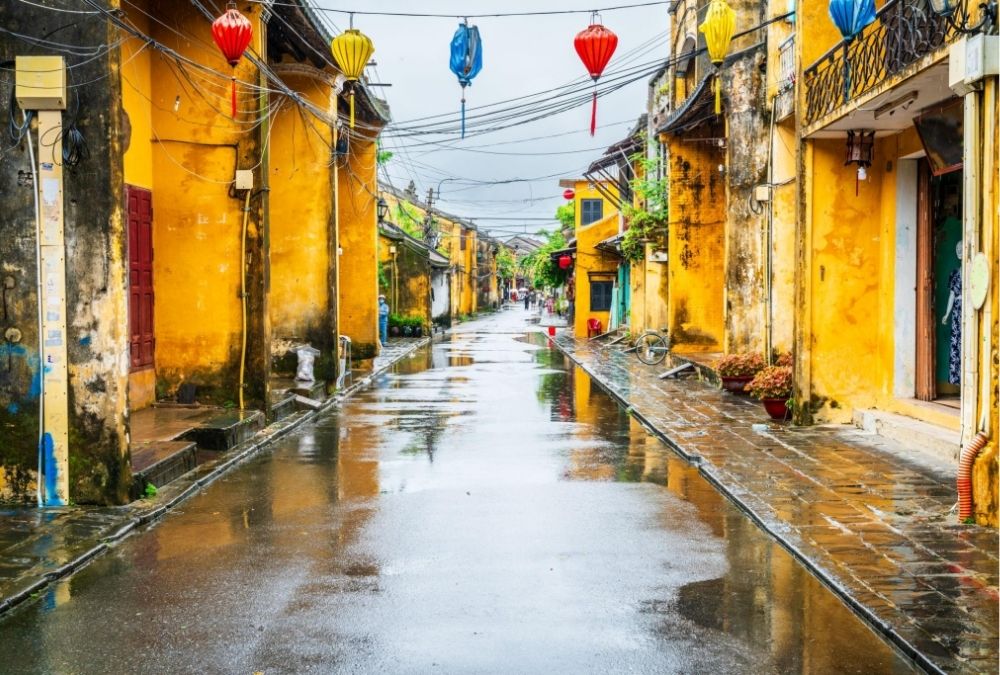
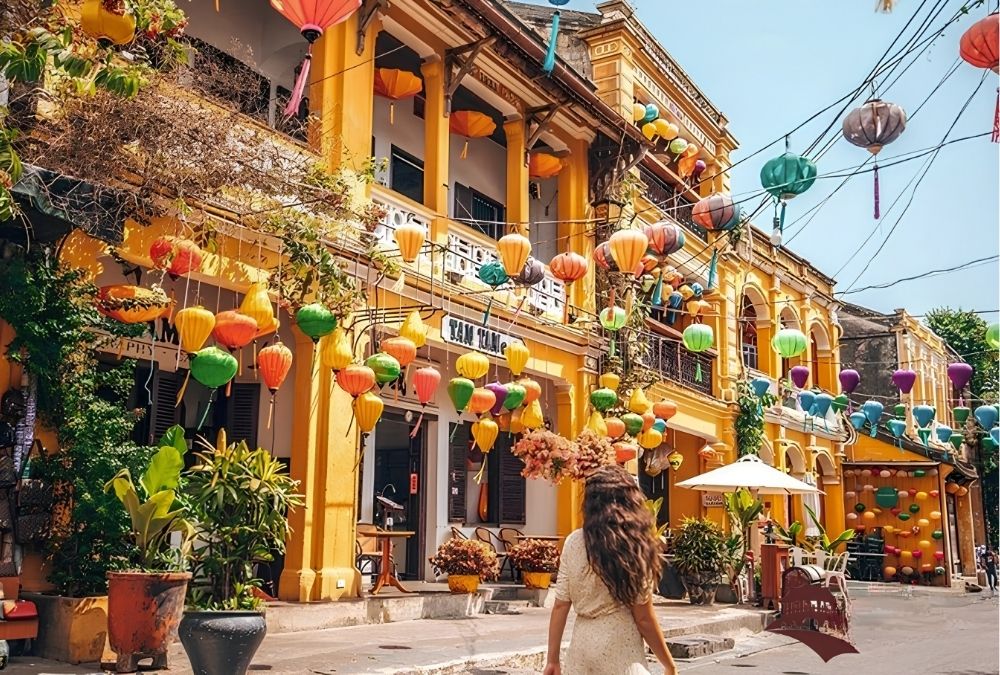
Most pictures of Hoi An show the same scene: mustard-yellow walls, silk lanterns in a row, late sun spilling over the Hoai River. That is the town of February and March. In October it looks different. Clouds sit low over the tiled roofs, showers arrive without warning, and now and then the river rises into the streets.
- Is October a good time to visit Hoi An?
- Hoi An weather in October: temperature, rain and humidity
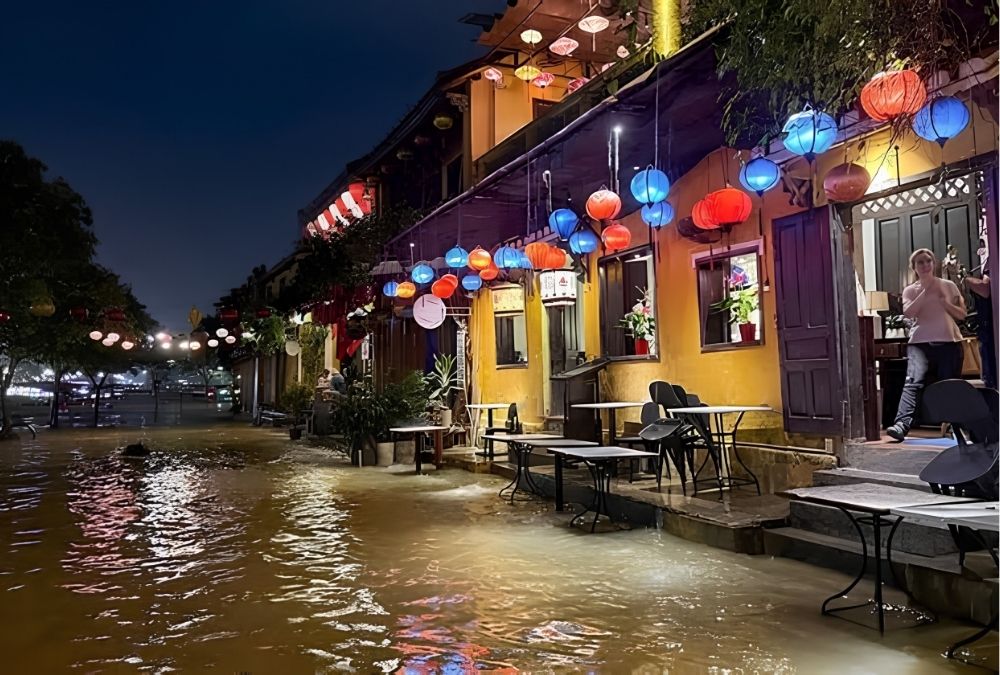
- The flood question: how October floods work in Hoi An
- Early, mid or late October: when to go
- What to do in Hoi An when it rains
- What to eat in Hoi An in October
- Old Quarter Full-Moon Night on October 23, 2026
- What to skip in Hoi An in October
- Where to stay in Hoi An in October
- Costs and getting there
- A flexible two-day plan for rainy weather
- What to pack for Hoi An in the rainy season
- Frequently asked questions
October is the least predictable month of the year for the town, and also one of the quietest. Visitors who understand how the rain and the water behave tend to leave with a good trip. Those who arrive expecting beach weather usually do not.
Is October a good time to visit Hoi An?
It depends on what the trip is meant to be. October is the start of the peak rainy season in central Vietnam, and it carries a real chance of flooding in the second half of the month. For travelers who want sunshine, swimming and island trips, it is one of the weakest months of the year.
For travelers who are happy with a slower, damper and less crowded Hoi An, it can be a rewarding month. The heat of summer is gone, daytime walking is comfortable, and the ancient town is far emptier than in peak season. Old houses, tea rooms and noodle shops all feel better when the weather is gray.
The table below sums up the trade-off.
| Factor | October in Hoi An |
| Rainfall | Among the two wettest months of the year, roughly 550 to 650 mm depending on the source |
| Temperature | Around 27 to 28°C by day, 22 to 25°C at night |
| Flood risk | Moderate early in the month, higher from mid-October |
| Crowds | Low, off-peak season |
| Beach and island trips | Poor, the sea is often rough |
| Best for | Culture, food, cafes, tailoring, slow travel |
| Not recommended for | Beach holidays, rigid schedules, island trips |
Hoi An weather in October: temperature, rain and humidity
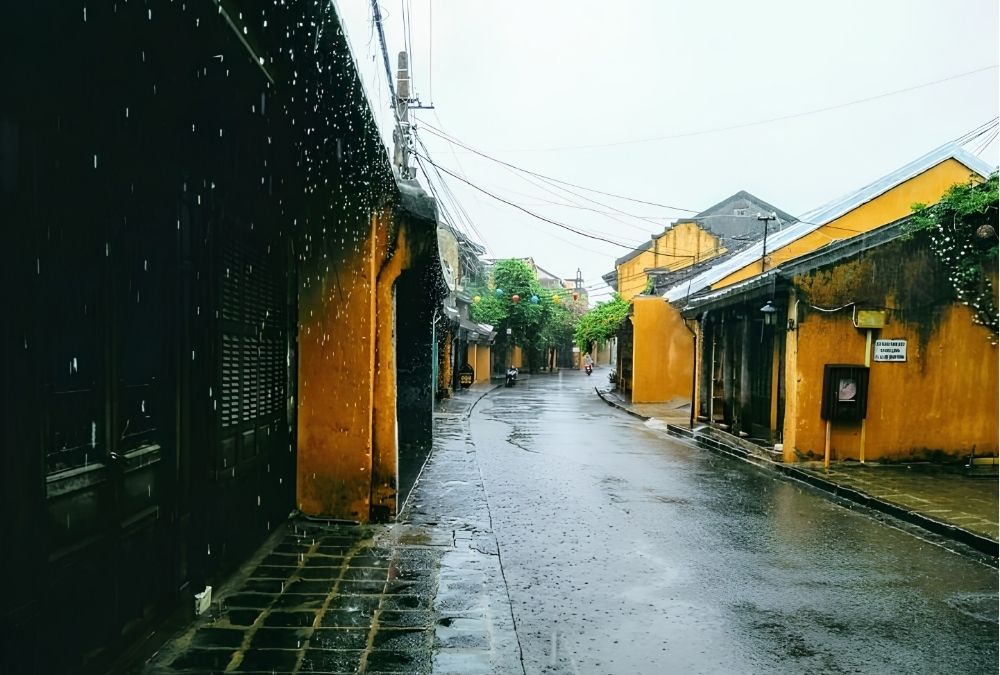
Hoi An has two clear seasons. The dry season runs roughly from February to August, and the wet season from September to January, with October and November the wettest.
Temperatures are mild by Vietnamese standards. Daytime highs sit around 27 to 28°C, and nights fall to roughly 22 to 25°C. That is far gentler than the 35°C days of June and July, which makes walking the old quarter easy even at midday.

On wet days evening readings can approach 90 percent, so laundry dries slowly, shoes stay damp and light clothes cling. Rain also comes in three distinct forms:
- Short heavy showers, lasting 15 to 30 minutes, after which the sky often clears. These are common early in the month.
- All-day drizzle under a flat gray sky, which is the type most likely to spoil an outdoor itinerary.
- Long spells of heavy rain linked to tropical depressions or storms, rarer but the main cause of flooding.
One point is easy to miss. The forecast for Hoi An alone does not tell the whole story. A dry, sunny day in town can still bring floodwater if heavy rain fell in the Thu Bon River basin upstream the day before, so travelers are advised to watch the forecast for the whole of Quang Nam and any announcements about hydropower discharges.
The flood question: how October floods work in Hoi An
Hoi An sits in the lower reaches of the Thu Bon River, and the Hoai River that runs past the old quarter is a branch of that system. When storms hit the mountains and reservoirs upstream release water, the Hoai can rise within hours. In October 2025, Nguyen Thi Hue, a 62-year-old resident, told Vietnamnet that the water rose so fast that the whole street became a river within a few hours (Source: Vietnam Net).

Flooding is not new. Bach Dang Street, which runs directly along the riverbank, is the lowest and first to go under. Tran Van Xung, a 79-year-old who has lived there for decades, told Dan Tri that the street typically floods eight to ten times in a rainy season (Source: Bao Dan Tri).
The most recent serious episodes show what the range can look like.
| Date | What happened |
| Early October 2020 | Authorities halted ancient town ticket sales as the river rose. Bach Dang Street was under about half a meter of water. |
| October 26 to 30, 2025 | A flood that the local press reported as higher than the 1964 peak. Main streets such as Tran Phu, Nguyen Thai Hoc and Bach Dang were under 0.5 to 2 meters, and craft villages and eco-tourism sites stayed under water for about three days. |
| November 2, 2025 | The ancient town began to reopen after the water receded and cleanup started. |
| November 17, 2025 | The river rose again, and local media counted it as the fourth flooding in a little over a month, though this time water was only knee-deep in low areas. |
These events do not mean every October is like 2025. Many years see only short, shallow flooding on riverside streets. The point is that the risk is real, can develop in hours and can last several days, so it should be part of any plan.
Since the 2025 administrative reorganization, Hoi An belongs to Da Nang City and is managed as a ward. Travelers searching for official announcements may find them under Da Nang rather than Quang Nam.
Early, mid or late October: when to go
For travelers with a flexible schedule, early October is generally the safer choice. Showers are frequent, but long disruptions are less common. From about mid-month, a refundable booking and a backup plan become much more important.
One date is worth planning around. The monthly Old Quarter Full-Moon Night falls on the 14th day of the lunar month, which in 2026 is Friday, October 23. It is the best single evening of the month, and it is covered in its own section below.
What to do in Hoi An when it rains
The town offers more to do under a roof than most visitors expect. Rainy days are in fact when many of its attractions are at their best.
Old houses and assembly halls
The ancient town holds dozens of heritage sites, including the Japanese Covered Bridge, the Fujian, Cantonese, Hainan, Trieu Chau and Quang Trieu assembly halls, and merchant houses such as Tan Ky, Phung Hung, Quan Thang and Duc An. Walking through them in rain is a quiet pleasure. The carved wood is darker, the courtyards smell of wet stone, and fewer groups crowd the rooms.


Many of the old houses have a skylight courtyard that opens to the sky. In rain, water from the yin-yang tiled roof falls into this courtyard with a distinctive drumming sound. Some houses also keep traces of past floods, such as upper lofts for storing goods, a reminder that residents have long lived with the river rather than against it.
The ancient town ticket is widely quoted at 80,000 VND (about US$3) for domestic visitors and 120,000 VND (about US$4.60) for international visitors, unchanged for many years. It covers entry to a limited number of the listed sites. Because prices can change, it is worth confirming at the ticket counter.
Museums
Hoi An has several small museums, including the Museum of Trade Ceramics, the Sa Huynh Culture Museum and the Museum of Folk Culture. They explain how a modest river port became a trading hub visited by Japanese, Chinese and Dutch merchants. A morning spent in two or three of them gives the streets outside more meaning afterward.

Cafes and tea rooms
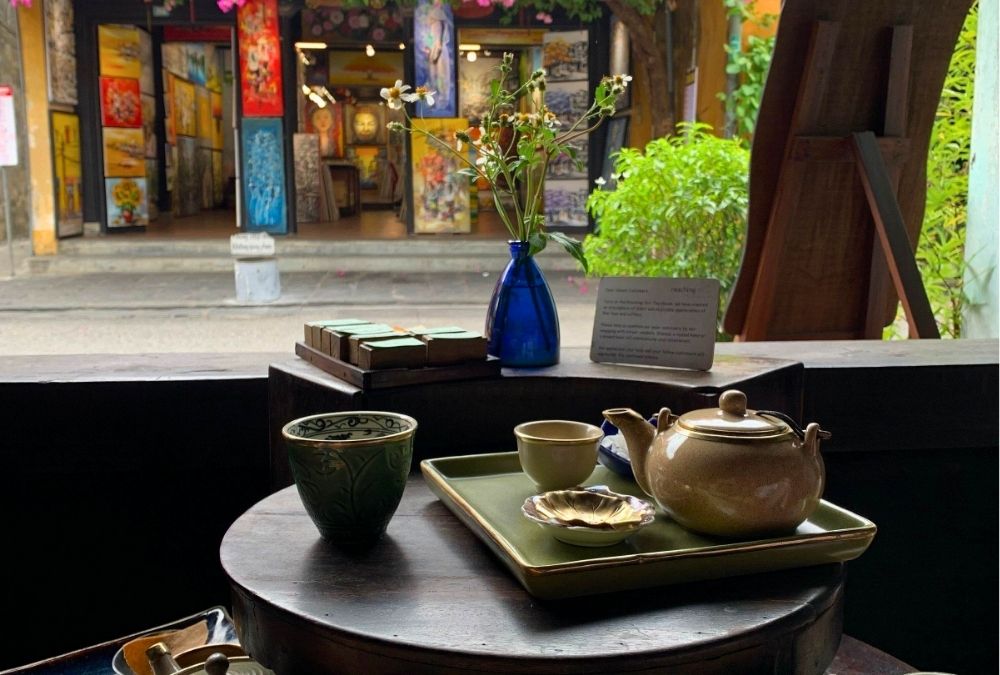
Hoi An’s cafés are an attraction in themselves, and many occupy century-old houses. Reaching Out Tea House is a calm spot staffed by hearing-impaired employees, and Hoi An Roastery suits those who care about their coffee.
On a wet afternoon, the best seat is by a window with a pot of hot tea. It costs little, takes no planning and is arguably the most characteristic Hoi An experience of the season.
Tailoring and cooking classes
Hoi An is known for tailors who can make a garment in one to two days. In the rainy season, shops are quieter, so there is more time for choosing fabric and fittings. Visitors are advised to compare several shops and agree in advance on the pickup time and the alteration policy.
Cooking classes, which often combine a market visit with a hands-on lesson, are another option. The Market-to-Table Cooking Class by Bicycle offers a way to experience Hoi An’s local food culture, from sourcing fresh ingredients to preparing traditional dishes. Because market visits and cycling may be affected by rain, ask the organizer how the itinerary is adjusted during wet weather.

What to eat in Hoi An in October
Hoi An food suits rainy weather unusually well. A bowl of hot noodles, a plate of chicken rice or a warm sweet soup tastes better when the street outside is gray. Most dishes are inexpensive, and a simple meal rarely costs more than a few dollars.
| Dish | What it is | Approximate price |
| Cao lau | Thick, chewy noodles with slices of pork, crisp pork rinds and fresh herbs from Tra Que village. Tradition says the noodles use water from the old Ba Le well and ash from wood burned on the Cham Islands. | 35,000 to 50,000 VND (about US$1.40 to 1.90) |
| Mi Quang | Wide rice noodles in a small amount of rich broth, served with peanuts, herbs and a rice cracker. | Around 30,000 to 50,000 VND (about US$1.20 to 1.90) |
| Com ga | Rice cooked in chicken stock and topped with shredded chicken, onion and Vietnamese coriander. Com Ga Ba Buoi is one of the best-known addresses. | Around 40,000 to 60,000 VND (about US$1.50 to 2.30) |
| Banh mi | Crisp baguettes filled with pork, pate, pickles and herbs. Banh Mi Phuong and Madam Khanh are the best-known stalls. | 25,000 to 40,000 VND (about US$1 to 1.50) |
| Banh xeo and nem lui | Small crisp pancakes and grilled pork skewers, rolled in rice paper with herbs and dipped in a thick peanut sauce. The Ba Le well lane is known for them. | Varies, usually under US$5 per person |
| White rose dumplings (banh bao banh vac) | Delicate translucent dumplings filled with shrimp or pork. | A few dollars per plate |
| Sweet soups and snacks | Che, tao pho, banh it and hen tron (a mix of baby clams, herbs and rice crackers). | 5,000 to 20,000 VND (about US$0.20 to 0.80) |

Popular places fill up quickly when it rains, because many visitors seek shelter at the same time. Smaller places in the side lanes usually have free tables and slightly lower prices. Herbal drinks such as those at Mot Hoi An are a gentle option for cool, damp evenings.
Read more: Hoi An Street Food Tour
Old Quarter Full-Moon Night on October 23, 2026
On the 14th day of every lunar month, Hoi An dims its electric lights. The old quarter glows with silk lanterns, and people release paper flower lanterns onto the Hoai River. Programs of traditional performances run through the evening, usually from about 6 p.m. until late, and some activities are included in the ancient town ticket.

In 2026, the October event falls on Friday, October 23. It tends to be the most crowded night of the month, even in the off-season. Arriving early for dinner, before the streets fill, gives a better chance of a table and a good view.
Boat rides to release lanterns are priced around 150,000 to 200,000 VND (about US$5.80 to 7.70) per boat for two people for a short trip, so asking the price before boarding is sensible. Riverside spots near An Hoi Bridge are the busiest. If the river is high or rain is heavy, activities on or near the water may be changed or cancelled, so a check of local announcements on the day is advisable.
Read more: Hoi An City Tour, Boat Ride & Flower Lantern Release
What to skip in Hoi An in October
Several well-known activities are a poor fit for the season. Skipping them avoids disappointment and wasted money.
- Cham Island trips: The best sea season is March to August. From about October onward, rough water means tourist boats often do not run, and wooden boats now carry mostly cargo and residents. Anyone who has booked a tour should choose a refundable option.
- Swimming at An Bang and Cua Dai: Waves are usually high in October, so the beaches are for walking and photography rather than swimming. Warning flags and lifeguards’ instructions should always be followed.
- Low-lying riverside attractions: Tra Que vegetable village, the Thanh Ha pottery village and the Bay Mau coconut forest sit close to water and can close when the river rises. A phone call to confirm is worthwhile before heading out.
- Long motorbike rides: Wet roads, poor visibility and hidden flooded sections make them risky. A bicycle around the old quarter and ride-hailing apps for longer distances are safer in rain.
Where to stay in Hoi An in October
Location matters more in the wet season than at other times. Bach Dang Street, on the riverbank, floods first, so accommodation there carries the most risk. Hotels with an upper floor, or rooms above ground level, are a sensible choice in any area.
Beach areas such as An Bang and Cam An are farther from the Hoai River, but roads into the old quarter can still be affected. Anyone staying there should consider how to reach the center if some roads are under water. Local hosts and hotel staff usually know the situation earlier than any app.
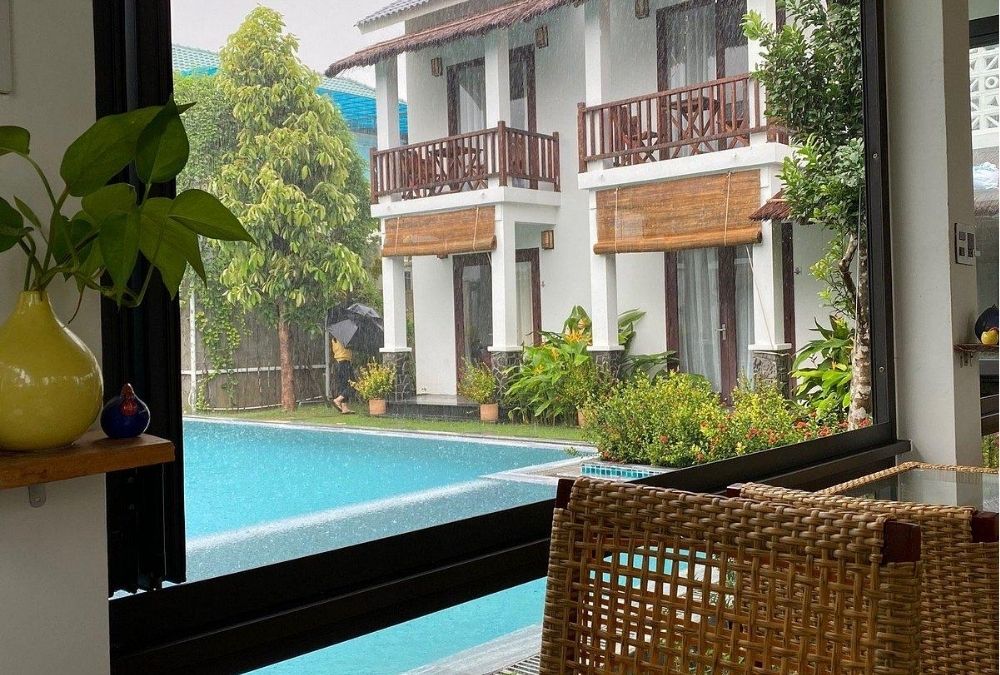
The most useful advice is also the simplest. During October, choose rooms and flights that can be changed or refunded, especially for trips in the second half of the month. A flexible booking is worth more than a small discount.
Costs and getting there
October is the low season, so flights and rooms are generally easier to find than at other times of year. Prices below are rough guides, and the conversions assume about 26,000 VND per US dollar.
| Item | Approximate cost |
| Return flight from Hanoi or Ho Chi Minh City to Da Nang | 1.5 to 3 million VND (about US$58 to 115) |
| Taxi or ride-hailing from Da Nang airport to Hoi An (about 30 km) | 250,000 to 350,000 VND (about US$10 to 13) |
| Bicycle rental | 30,000 to 50,000 VND per day (about US$1.20 to 1.90) |
| Motorbike rental | 120,000 to 150,000 VND per day (about US$4.60 to 5.80) |
| Simple meal at a local eatery | 35,000 to 60,000 VND (about US$1.40 to 2.30) |
| Sit-down meal at a restaurant | 100,000 to 180,000 VND (about US$3.80 to 6.90) |
| Ancient town ticket | 80,000 VND (about US$3) domestic, 120,000 VND (about US$4.60) international |
A flexible two-day plan for rainy weather
October brings a mix of rainy afternoons and occasional dry spells to Hoi An. A two-day trip works best when the Ancient Town takes priority, with countryside activities kept flexible.
Day 1: Explore the Ancient Town
- Morning: Start with cao lau or mi Quang at a local eatery, then walk through the Ancient Town’s yellow-walled streets. Visit the Japanese Covered Bridge, an old merchant’s house and a traditional assembly hall to get a feel for Hoi An’s trading history.
- Afternoon: Take a break at a riverside café, browse independent shops or visit a museum. If rain sets in, spend longer inside heritage houses instead of rushing between attractions.
- Evening: Enjoy local food for dinner, then stroll along the Hoai River to see the lanterns reflected on the water when the weather permits.
Day 2: Countryside, coast or local crafts
- Morning: On a dry day, cycle through the rice fields and village lanes around Tra Que Vegetable Village, or head towards Cam Thanh for a glimpse of rural life beyond the town centre.
- Afternoon: Enjoy a countryside meal before returning to town. If it rains, replace the outdoor excursion with a Vietnamese cooking class, a visit to a museum or a tailor appointment in the Ancient Town.
- Evening: Try banh xeo with fresh herbs, followed by che for dessert. If the rain eases, finish the trip with another walk along the river or a relaxed café stop.
If you have a third day: Keep it for a beach visit or a longer countryside excursion. This leaves room to enjoy Hoi An at a slower pace rather than squeezing every activity into two days.
What to pack for Hoi An in the rainy season
- A light rain jacket or poncho, which is easier than an umbrella on a bicycle.
- Sandals or quick-drying shoes, rather than canvas sneakers that stay wet for days.
- A waterproof pouch for phone and documents.
- A spare set of clothes in a small bag, since humidity slows drying.
- A thin layer for cool evenings.
- A power bank for checking forecasts and messages.
Frequently asked questions
Is it worth visiting Hoi An in October?
Yes, for travelers who accept the weather risk and want a quieter town with food, cafés and culture. No, for those who want sunshine, beaches or a rigid schedule.
Can visitors swim in October?
Swimming is not recommended, because the sea is usually rough. The beaches are better for walking and viewing.
Are Cham Island tours available in October?
Often not. Boats are frequently cancelled because of rough water, so only refundable bookings are advisable.
What festival takes place in October 2026?
The monthly Old Quarter Full-Moon Night falls on Friday, October 23, 2026, the 14th day of the lunar month.
Is October cheaper than other months?
Often, since it is off-season, but prices vary. Comparing a few options is better than assuming.
Hoi An in October is not the postcard version of the town. It is damper, grayer and less certain, and for some travelers that is a reason to stay away. For others it is exactly the appeal.
The sound of rain on old tiles, a bowl of steaming noodles in a nearly empty lane and a flood mark on a wooden pillar show a Hoi An that has lived with water for more than four centuries. A rain jacket, a flexible booking and a backup plan are all the preparation it takes. The old town handles the rest.